
Toronto's Real Estate Market Plummets: A Grim Picture as Home Sales and Prices Decline Sharply
The Plunge in Home Sales and Prices Signals a Pivotal Moment in Toronto's Real Estate Market
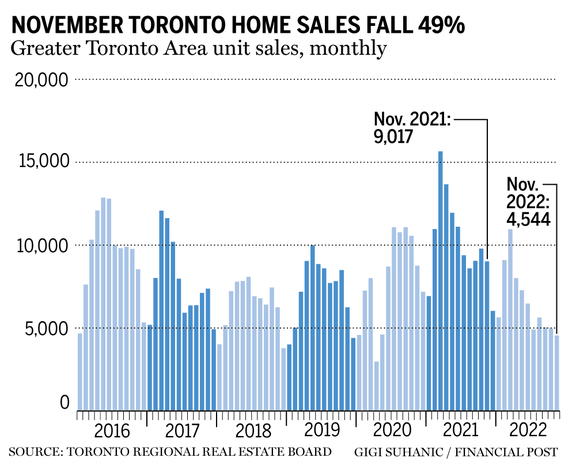
The Greater Toronto Area (GTA) real estate market is experiencing its most significant downturn in recent memory, with home sales and prices in February 2026 falling sharply compared to the previous year. According to the Toronto Regional Real Estate Boards (TRREB), home sales declined by 6.3% from 4,127 in February 2025 to just 3,868 in February 2026. The average selling price also dropped by 7.1%, down to $1,008,968, reflecting a staggering loss of $77,618 in market value compared to the same month in 2025. These figures are underscored by a 17.7% year-over-year drop in new listings, signaling a significant decrease in the supply of available homes.
These trends are not isolated to the GTA; the condominium market, which has been a focal point of the real estate crisis, is also struggling. The Building Industry and Land Development Association (BILD) and Altus Group reported an abysmal 85 new condominium unit sales in January 2026, marking a 16.7% decline from the previous month. This figure is a stark contrast to the previous year, when sales were consistently in the thousands. The decline in sales is driven by a broader market correction, with price declines across the board showing no signs of abating.
Affordability Pressures and Consumer Sentiment
The downturn in the GTA and the condo market is exacerbated by ongoing affordability pressures. The Toronto Real Estate Board’s (TRREB) report highlights that homebuying intentions declined by five percentage points in 2026, falling to 22% despite improvements in affordability. This suggests that even as prices have fallen, homes remain out of reach for many potential buyers. The average selling price in the GTA dropped to $973,289 in January 2026, down 3.3% from December 2025 and down 6.5% from January 2025. The median price, at $840,000, also declined, down 1.2% month-over-month and 7.7% year-over-year.
These trends are expected to continue as the economy remains resilient, and consumer confidence strengthens. However, the TRREB warns that the market may not fully recover until the second half of the year. The Ipsos Home Buyers Survey suggests that many would-be homebuyers are waiting for prices to level off before entering the market, hoping to benefit from even more affordable prices in the future.
Expert Analysis and Future Outlook
Experts are divided on when the market might recover. While some believe that the market will bounce back, others are more pessimistic. Daniel Steinfeld, the president of TRREB, remains optimistic, stating, "If new listings continue to trend lower through the spring, competition between homebuyers will increase, supporting home prices and a recovery in sales." However, experts like Dan Eisner, founder and CEO of True North Mortgage, see no signs of an imminent turnaround. Eisner argues, "I don’t see a bottom yet; there could be more weakness to come."
The broader housing market in Canada is also facing challenges, with a new CMHC Housing Affordability Composite Index showing that the crisis is not limited to Toronto and Vancouver. Cities like Ottawa, Montreal, and Halifax are experiencing significant affordability issues, highlighting the need for a more comprehensive approach to addressing the housing crisis across the country.
Conclusion: A Market in Transition
The downturn in Toronto’s real estate market is a complex and multifaceted issue. While prices are falling, the overall affordability and availability of homes remain a significant concern. As the market adjusts, both buyers and sellers need to navigate this challenging landscape with caution. The key will be to monitor trends closely and prepare for a potentially protracted period of market volatility. Only time will tell when and how the market will recover, but the current situation is indeed a pivotal moment for the future of housing in Toronto.
As we move forward, the focus will be on understanding the underlying factors driving the market and implementing policies that can help stabilize and improve the housing situation for Canadians. The coming months will be critical in determining the direction of this market and the broader implications for Canada's economic landscape.